
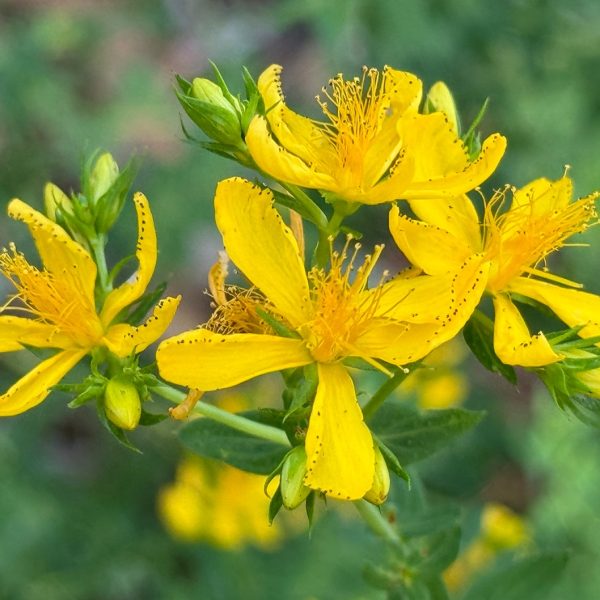






Goldenseal is one of herbal medicine’s most effective plants. As with many species that are effective but also slow-growing in niche habitats, uncontrolled harvesting has led to its decline in the wild.
Here we share some insights on its status in North America and what can be done to ensure its sustainable supply into the future.
The trials and tribulations of goldenseal

United Plant Savers logo is the iconic goldenseal, an American Heritage plant that is threatened due to habitat loss and harvesting pressures on wild populations. United Plant Savers has an At-Risk and a simple to use at-risk tool assessment. The roots can be easily propagated and thus embodies the wisdom of conservation through cultivation. United Plant Savers launched the Hope for Hydrastis project in 2019, a five-year program to cultivate goldenseal with the intention to provide forest farmers planting material to support a transition from wild harvest to cultivated. United Plant Savers also runs the Forest Grown Verified program that verifies farmers who are growing forest botanicals.
It can be practically impossible to know what is going on with wild populations as there are few resources for botanists to monitor populations and the herbal trade is not mandated to report raw materials in trade. What we do know is that the price of goldenseal has increased dramatically and demand far out weights supply. In recent years goldenseal prices for dried root have gone from $40 to over $80 dollars and to the end consumer as much as $100 dollars for just 4 oz, which is $400 a pound.
The conservation status of Goldenseal is complicated, it is CITES (Convention of International Trade of Endangered Species) listed on Appendix 2 and cannot be exported without a permit. The IUCN reviewed and listed Goldenseal as Vulnerable species and Herbal gram featured a detailed article on the intricate process that resulted in this assessment.
Canada has its own listing as “Threatened” and in the United States each state has its own status of conservation listings as you can see in the image below. The United Plant Savers indicate that this species is under pressure in their native habitats either due to habitat loss by overharvesting for their medicinal and/or ornamental uses. These species face serious pressures for the survival of healthy populations, as a result careful and continual monitoring of these populations is essential with particular focus on trade and supply.

Botanical information for goldenseal
Latin Name: Hydrastis canadensis
Standard Common Name: Goldenseal
Other Common Names: yellow puccoon, yellow root
Additional names: orangeroot, ground raspberry, eyebalm, eyeroot, golden root, Indian dye, Indian turmeric, jaundice root, orange root French: Hydraste du Canada, Sceau d’or
Family: Ranunculaceae
Botany: Hydrastis canadensis (goldenseal) is an herbaceous perennial yellow rhizome from which 1 to 8 stems grow to 8 to 14 inches. Each stem has 1 to 3 palmate leaves and mature plants produce a single white flower with many stamens and a bright red berry.
Lifespan: Slow-growing herbaceous perennial
Reproductive Age: Reproduction can be clonal or by seed. Seed production begins about 4 to 5 years. Clonal division is more prevalent, and clonally propagated plants may mature earlier than plants started by seed.
Geographic Region and habitat: Deciduous woodland understories and forest edges with moist rich soil having good drainage and a pH of 5.5 to 6.5. Found in Ontario, Canada, and the Eastern United States(Alabama, Arkansas, Connecticut, Delaware, Georgia, Illinois, Indiana, Iowa, Kansas, Kentucky, Maryland, Massachusetts, Michigan, Minnesota, Mississippi, Missouri, New Jersey, New York, North Carolina, Ohio, Pennsylvania, Tennessee, Vermont, Virginia, West Virginia, Wisconsin). The most populations are found in Ohio, Illinois, Indiana, and eastern Kentucky.
Find out more about this herb and its traditional uses on our goldenseal page.
Conservation status details

Ability to withstand disturbance and comments on vegetative reproduction and *obligatory relationships with other organisms if applicable
Overharvesting and habitat loss continue to be the primary threats. Populations on the edges of forests and wetlands thrive and the closing of tree canopy can negatively impact growth. Therefore some very selective human intervention, such as the creation of trails, careful tree thinning, removal of invasive species may be beneficial. There are no known obligatory relationships for reproduction.
Vulnerability of habitat and noted changes in habitat quality or availability as well as primary threats to habitat
The most significant threats to the plant is overharvesting and loss of habitat. Most known populations are in decline or stable.
Part of plant used and impact on recovery, time of year and period for harvest
The rhizome is the primary part used, and is harvested in the autumn after foliar dieback. Studies have shown that there is a correlation between a late harvest allowing larger rhizomes to develop, and the ability of a population to more successfully repopulate the following years. The leaf of the plant is also used.
Demand and relative acreage needed to meet demand
Global trade is controlled by CITES (US Forest Service, 2010). Wild harvest occurs mostly in southern Appalachia and Missouri by small-scale diggers which make up most of the wild-harvesting.
Recommendations for using goldenseal sustainably

Availability of alternatives or cultivated options
Cultivated goldenseal is commercially available, and makes up most of the commercial market. Goldenseal has several medicinal actions, and there is no one plant that is completely analogous.
However, there are many plants that provide similar actions such as berberine containing species like barberry, Berberis vulgaris.
Recommendations for industry
United Plant Savers recommends that At-Risk plants should be used in cultivated forms whenever possible. Because of pressures facing these plant populations and significant variability in abundance, wild-harvesting should be very limited and carefully monitored.
Any wild harvest of these plants should align with 1) rules established by federal, state and local governments and 2) the sustainable harvest guidelines outlined in individual UpS plant profiles.
Recommendations for home use
United Plant Savers recommends that At-Risk plants should be used in cultivated forms whenever possible. If the transition to entirely cultivated plant materials isn’t immediately possible, a self-regulated goal to reduce the wild-harvested plant materials is strongly encouraged.
To decrease pressure on At-Risk plants, consideration should be given to possible alternatives or analogs to these plants. Limited wild-harvests may be considered if locally abundant populations are identified, populations are closely monitored and harvests are conducted in accordance with federal, state & local regulations and the sustainable harvest guidelines outlined in individual UpS plant monographs.
Other status
Canada Federal Species at Risk Act: Threatened
Ontario Provincial Endangered Species Act: Threatened
International Union for Conservation of Nature (IUCN) Red List: Vulnerable; A taxon is Vulnerable when the best available evidence indicates that it meets any of the criteria A to E for Vulnerable (see Section V), and it is therefore considered to be facing a high risk of extinction in the wild.
CITES (Convention on International Trade in Endangered Species of Wild Fauna and Flora): Underground parts (i.e. roots, rhizomes): whole, parts and powdered listed in Appendix II (species not necessarily threatened with extinction, but in which trade must be controlled in order to avoid utilization incompatible with their survival.) Harvest and market controlled by US Fish & Wildlife permits
NatureServe: Rounded Global Score: Vulnerable (S3); US National Score: Vulnerable (S3); Canada National Score: Imperiled(S2): State Ranking: Critically Imperiled(S1): Connecticut, Kansas, Massachusetts, Minnesota, New Jersey, Mississippi, Vermont; Imperiled(S2): Ontario(Canada), Alabama, Georgia, Maryland, Michigan, New York; Vulnerable (S3): Delaware, Indiana, Iowa, North Carolina, Virginia, West Virginia(S3S4), Wisconsin(S3S4); Apparently Secure (S4): Illinois, Kentucky, Pennsylvania, Tennessee, Ohio(S4S5); Secure(S5) Missouri; Not Ranked(SNR) Arkansas.
United Plant Savers: At Risk Evidence indicates these species are under pressure in their native habitats either due to habitat loss or by overharvesting for their medicinal and/or ornamental uses. These species face serious pressures for the survival of healthy populations, as a result careful and continual monitoring of these populations is essential.
Resources
- For an understanding IUCN and Status assesments
- If you want to grow goldenseal, this is a very useful website: Grower Guide from UPS
References
- NatureServe Explorer 2.0. Explorer.natureserve.org. https://explorer.natureserve.org/Taxon/ELEMENT_GLOBAL.2.154701/Hydrastis_canadensis. Published 2022. Accessed January 11, 2022.
- Conservation Assessment For Goldenseal (Hydrastis Canadensis) L. USDA Forest Service, Eastern Region, 2003, www.fs.usda.gov/Internet/FSE_DOCUMENTS/fsm91_054345.pdf.