






Raw or cooked, warming or cooling, breakfast or dinner — Danny Blyth explores how Chinese nutritional therapy invites foods choices that align with constitution, season and environment.
Does Chinese nutritional therapy, Chinese medicine’s approach to diet and nutrition, have anything new to say in a world bombarded with conflicting dietary advice? Yes. It combines deep wisdom, a common-sense approach, and an energetic understanding of food that cuts through the confusion and reconnects us with the simple joy of food.
Qi Bo discusses diet and lifestyle in the first chapter of the Suwen (Simple Questions), part of the Huangdi Neijing (Yellow Emperor’s Classic of Internal Medicine), a foundational text of Chinese Medicine traditionally dated to more than 2,000 years ago (1).
In the past people knew of The Way. They conformed with yin and yang (night and day, rest and activity, etc.), harmonised with the changing seasons, ate and drank regularly and moderately, regulated their sleep, and didn’t overwork. They were thus able to keep body and spirit complete and live out their heaven-allotted one hundred years.
Nowadays people drink wine as though it were water, are foolishly irregular with their habits, and make love whilst drunk. By exhausting their essence, they scatter their true qi (vital energy). They fail to regulate their spirit, pursue immediate pleasure, and sleep without regularity. They are at odds with life’s [real] happiness. Is it surprising that at fifty years old they decline?”
The demonisation of food and a perfect diet

Certain foods are often described as ‘superfoods’, or ‘bad’. Food fashions and nutritional advice change vastly over time. Food can easily become the enemy, and the pleasure in both cooking and eating it lost. The Chinese nutritional therapy approach is different. Every food can be useful in the right context, and in the right proportion.
For example, dairy is rich, dense and very nourishing for the yin and fluids. For somebody who is yin deficient (for example hot, dry and agitated), dairy can be a health-promoting food. For individuals with an excess of fluids manifesting as phlegm, congestion, muzzy head or bloating, too much dairy can make things worse. Drinking milk is very different for a young vigorous child, a pregnant woman growing new life, and a middle-aged sedentary office worker.
The bulk of a balanced diet ought to be made up of foods that are minimally processed. Shop bought potato waffles are cooked, mashed, mixed with oil and stabilisers, pressed, fried and frozen before they are prepared for eating at home. From a Chinese nutritional perspective, is this different from a potato that is dug from a garden and cooked? TCM stipulates that ‘light and simple’ (qīngdàn) foods — vegetables, unprocessed grains and pulses should constitute most of the diet, and foods that are rich and processed (oily foods, soy sauce, sugar) should make up just a small part.
No food is good or bad, and no single diet is right for every person. Instead, considering constitution, situation (exercise levels, or stress), and environment (is the weather hot, cold or humid) and adjust diet accordingly to the cycles of life. Any condensed or highly processed foods also should be eaten proportionally less.
An energetic approach to food: Flavour and temperature

In Chinese medicine, the nature, energetic ‘temperature’, and flavour are considered the most important indicators of how nourishing and beneficial a food is. Food is traditionally designated an energetic temperature, from cold, cool, neutral to warm and hot, and a balance of the five flavours (spicy, sour, sweet, bitter and salty) (2).
In Chinese medicine theory, individuals of a ‘cold’ nature (feeling cold, wearing more layers, feeling sluggish and tired) need more warming foods (onion, pepper, butter, lamb, slow cooked food). Likewise, those who are ‘hot’ in nature (feeling hot, wearing less layers, feeling agitated and restless) need more cooling foods (salads, fruit, fast growing veg) and should avoid heating foots (alcohol, deep-fried food). Neutral foods (like rice, squash, carrot) are the most moderate in nature. Interestingly, many cultures use these ‘neutral’ foods to wean babies.
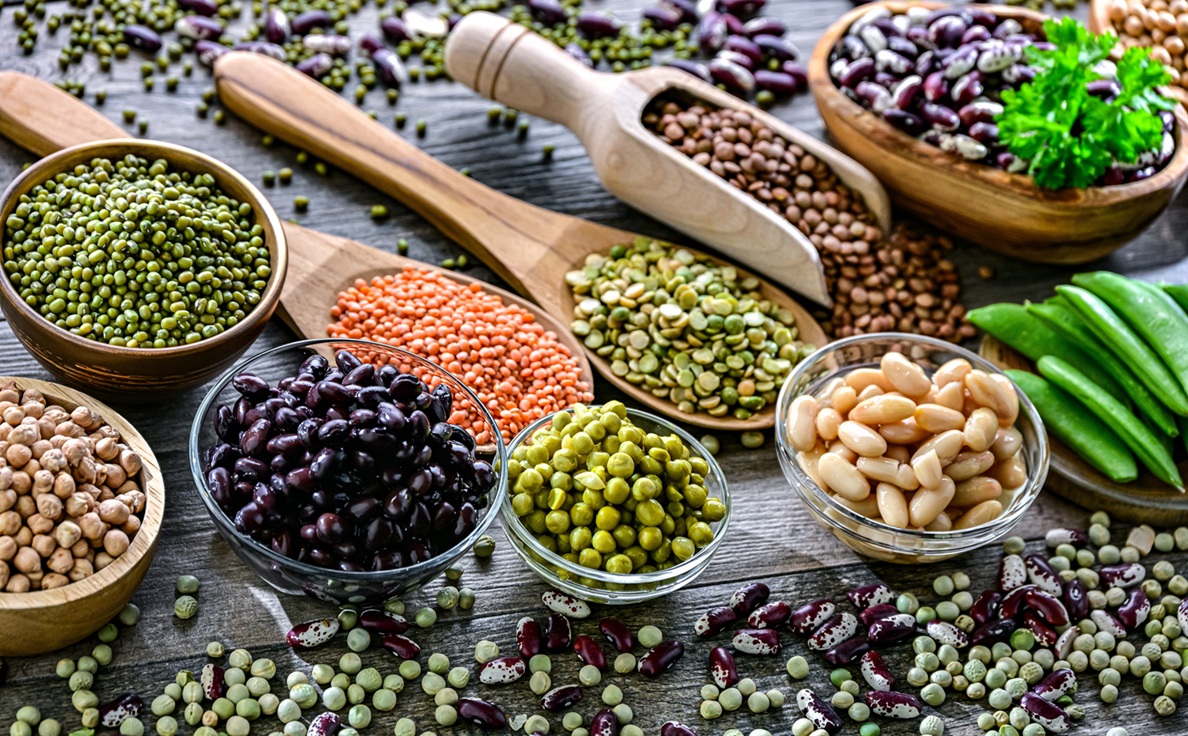
In Chinese nutritional therapy, mung beans are considered sweet (nourishing, harmonising) and cool in nature, a great tonic to nourish deficient yin (night sweats, agitation, disturbed sleep) and deficient blood (feeling tired, postural dizziness, difficulty getting off to sleep). Their harmonising cooling nature also traditionally clears heat and toxicity.
Changing the flavour and temperature
Humans have to process foods in order to digest them well (cooking, pickling, chopping, etc.). Human evolution has been defined by our ability to cook food, thus increasing the available calories — this is one theory of how brain size evolved (3,4). Humans’ nearest relatives, chimpanzees, spend considerably more time chewing every day — apparent from their developed jaws (5).
Processing food also changes its temperature and nature in Chinese medicine theory. Raw food is considered the most cooling and hard to digest, deep-fried or baked food more heating. Steaming or stir-frying foods are more moderate ways of cooking.
Consider an onion from a Chinese nutritional therapy perspective. Raw it is warming, spicy and drying, useful for phlegm congestion, or a head-cold. Slow cooking onion reduces its spicy nature, and increases its sweetness, making it a gentle tonic, traditionally considered to strengthen and harmonise the digestive system. It is especially useful to help digest pulses and rich foods, hence onions’ wide use in cooking.
Microcosm/macrocosm and resonance
An important theory in Chinese philosophy is the way things resonate and interact (ganying) (6). Nothing exists or functions independently. The physical body, mind/emotion and spirit/intellect are examples of three levels that resonate and interact with each other. Foods have a resonance that affects all of these levels. On a micro level, how foods support our digestive systems, and gut bacteria can be considered; on a macro level, how food choices impact environment. Our choices resonate outwards, and inwards.
When to eat
One of these resonances suggests that internal organs work on a 24-hour cycle wherein the vitality and strength of each organ or system waxes and wanes in harmony with the daily cycling of the sun. According to this traditional body clock theory, the digestive system peaks between seven and eleven am, and is at its weakest and least efficient between seven and eleven pm.
For this reason, breakfast is considered extremely important, and eating or snacking late in the evening is discouraged. Hence expressions like “eat a small amount of food for dinner, live until ninety nine” abound. This is also expressed as “breakfast like a king, lunch like a prince and dinner like a pauper” (often attributed to Adelle Davis). A Russian proverb expresses it beautifully as “eat your breakfast alone, share lunch with a friend, and give your supper to an enemy”!
In fact, salivary glands significantly reduce saliva production during the night, which can contribute to morning breath and dry mouth (7). Modern chrononutrition research is exploring some interesting parallels, including whether distributing food intake earlier in the day may benefit metabolic health (8). Shift work and circadian misalignment are associated with adverse metabolic and cardiovascular outcomes, and experimental research suggests that misalignment can alter glucose, insulin, cortisol and blood-pressure regulation (9).
What, why and how

Not only does Chinese nutritional therapy consider what is eaten, and when it is eaten, but also how it is eaten. Too often food is understood out of the context of who is eating it, and where and when it is being eaten. With lists of ingredients, detailing the macro and micro nutrients, a mechanical and analytical understanding arises that can miss the vital relationships with food, and with environment.
Modern microbiome research is also encouraging a broader consideration of food. Rather than viewing foods simply as collections of individual nutrients and chemicals, researchers are increasingly interested in how whole foods and dietary patterns interact with individual microbiomes and metabolism (10).
The food itself is also essential to consider. Where does the food come from? How is it produced? How much is it processed? Is it in season? Consideration of the person eating it too is needed. Are they relaxed, hungry, energised, and happy when eating? How long do they take to eat? How many times do they eat in a day? What else are they doing when they eat?
Perhaps the most valuable lesson Chinese nutritional therapy offers is not another set of dietary rules, but a different way of thinking about food. Rather than asking simply, “Is this food good or bad?”, one can ask: “Is it right for this person, now, and in this context?” By paying attention to what, when, why and how food is eaten, a more flexible and enjoyable relationship with food can be developed — one that respects both the wisdom of tradition and what modern nutrition continues to teach us.
Author’s note: Concepts such as qi, yin and yang, resonance, food temperature and constitutional patterns belong to the traditional theoretical framework of traditional Chinese medicine. This framework differs from the models used in modern nutrition and physiology. In places, I have pointed out where modern research may offer interesting parallels. For further reading on the theoretical foundations of Chinese Medicine, see
Chinese Medicine: The Web That Has No Weaver by Ted J Kaptchuk (11). For more information about Chinese nutritional therapy, talk to your local fully qualified acupuncturist or Chinese herbalist.
References
- Unschuld PU, Tessenow H. Huang Di Nei Jing Su Wen: An Annotated Translation of Huang Di’s Inner Classic—Basic Questions. Vols 1-2. University of California Press; 2011.
- Chinese Medicine Regulatory Office, Department of Health, Hong Kong SAR. Health preservation by food in Chinese medicine: the five cereals, fruits and vegetables. Accessed [October, 2026]. https://www.cmro.gov.hk/html/eng/useful_information/public_health/publication/Health_Preservation_by_Food_in_CM.html
- Wrangham R. Catching Fire: How Cooking Made Us Human. Basic Books; 2009.
- Carmody RN, Wrangham RW. Cooking and the human commitment to a high-quality diet. Cold Spring Harb Symp Quant Biol. 2009;74:427-434. https://doi.org/10.1101/sqb.2009.74.019
- Zink KD, Lieberman DE. Impact of meat and Lower Palaeolithic food processing techniques on chewing in humans. Nature. 2016;531(7595):500-503. https://doi.org/10.1038/nature16990
- Perkins F. Metaphysics in Chinese philosophy. In: Zalta EN, Nodelman U, eds. Stanford Encyclopedia of Philosophy. Published April 2, 2015. Updated October 16, 2023. Accessed [October, 2026]. https://plato.stanford.edu/entries/chinese-metaphysics/
- Thie NM, Kato T, Bader G, Montplaisir JY, Lavigne GJ. The significance of saliva during sleep and the relevance of oromotor movements. Sleep Med Rev. 2002;6(3):213-227. https://doi.org/10.1053/smrv.2001.0183
- Jakubowicz D, Barnea M, Wainstein J, Froy O. High caloric intake at breakfast vs. dinner differentially influences weight loss of overweight and obese women. Obesity (Silver Spring). 2013;21(12):2504-2512. https://doi.org/10.1002/oby.20460
- Scheer FAJL, Hilton MF, Mantzoros CS, Shea SA. Adverse metabolic and cardiovascular consequences of circadian misalignment. Proc Natl Acad Sci U S A. 2009;106(11):4453-4458. https://doi.org/10.1073/pnas.0808180106
- Spector T. The Diet Myth: The Real Science Behind What We Eat. Weidenfeld & Nicolson; 2015.
- Kaptchuk TJ. The Web That Has No Weaver: Understanding Chinese Medicine. 2nd ed. Contemporary Books; 2000.