




Sciatica remains a major public health problem worldwide resulting in significant socio-economic, physical, and psychological impacts (2).
Understanding sciatica
Sciatica is pain along the sciatic nerve, which is a common and sometimes debilitating condition. It is thought to be experienced by up to 40% of people at some point in their life (1), with peak incidence occurring in the fourth decade of life.
Sciatica remains a major public health problem worldwide resulting in significant socio-economic, physical, and psychological impacts (2).
Why does sciatica happen?

Sciatica is characterised by pain or paresthesis in the sacral root distribution, which is directly resulting from sciatic nerve or root pathology.
The sciatic nerve is comprised of nerve roots from L4 to S3, which fuse to create the sciatic nerve. It exits the pelvis posteriorly (at the back of the pelvis) through the sciatic foramen. The nerve then passes below and in front of the piriformis muscle, and behind other pelvic muscles. The sciatic nerve travels down the back of the thigh, and terminates at the back of the knee, where it branches into tibial and fibular nerves which innervate the back and outer edge of the lower leg and foot (1).
The sciatic nerve has a diameter of up to 2cm, making it the body’s largest nerve. The pathophysiology of sciatica is symptoms occurring anywhere along this nerve pathway, which can be due to different causes but are generally linked to compression of the sciatic nerve root. This compression can lead to local oedema (swelling), ischemia (lack of blood supply), and, consequently, inflammation that may cause leakage from the degenerated intervertebral discs (2).
Lower back pain or radicular leg pain is often mislabelled as sciatica. One way to differentiate is that the pain of sciatica tends to be exacerbated by lumbar spine flexion (forward bending), twisting, bending, or coughing (1).
Understanding the root causes
The cause of sciatica is often structural, due to compression of the sciatic nerve root, with nearly 85% of cases being associated with disc disorders (3).

Common causes of sciatic nerve compression are (4):
- Intervertebral disc herniation
- Bony irregularities (such as osteoarthritic or osteocytes)
- Spinal stenosis
Another condition called piriformis syndrome can be mistaken for sciatica because both create pain in the sciatic nerve. Piriformis syndrome is a spasming or tightening in the piriformis muscle, located in the buttock.
The piriformis muscle can irritate the sciatic nerve due to their close proximity to one another, causing similar symptoms to those experienced in sciatica, such as buttock pain, numbness, and tingling down the back of the leg and into the foot. In these cases of sciatic pain, it can be due to the entrapment of the sciatic nerve by the inflamed piriformis muscle at the level of the ischial tuberosity, rather than at the nerve root which tends to be the case more often with sciatica. It is estimated that piriformis syndrome is responsible for up to 6% of all lower back pain /sciatica cases (5).
Risk factors for sciatica include physical stress on the spine such as regular lifting and whole-body vibration, which may be linked to occupation, such as jobs requiring prolonged standing and bending, heavy manual labour, and heavy lifting. Other risk factors include smoking, obesity, history of lower back pain, and psychological stress such as monotonous work and depression (2).
A systematic review of articles on sciatica found that most risk factors reported were modifiable and associated with an unhealthy lifestyle (6). A more recent review of the prevention, management and treatment of sciatica recommends walking and cycling as preventative measures against sciatica in the general population (2).
There are questions around the real effectiveness and benefit of painkillers such as NSAIDs in the treatment of sciatica. Some studies reported some short-term benefit for anticonvulsants such as gabapentin for the treatment of chronic sciatica, however showing adverse effects higher than those of placebo (2).
Signs and symptoms

There are a range of symptoms with sciatica, which can include (7,8):
- Lower back pain
- Leg pain (often this feels worse than back pain)
- Change in sensation in the bottom, leg or foot
- Muscle spasms in the back
- Weakness in the leg or foot
Change in feeling in the leg or foot can include:
- Pins and needles
- Numbness
- Hot or cold
- Burning sensations
- Shooting sensations
- Stabbing pain
- Sensations that can be hard to describe
It is important that if you have the following symptoms, you seek medical immediate attention as they could be symptoms of a serious back problem (8):
- Sciatica on both sides
- Weakness or numbness in both legs that’s severe / getting worse
- Numbness around or under genitals, or around anus
- Difficulty to start peeing, cannot pee or cannot control when you pee (which is not normal for you)
- Do not notice when you need to pass a stool or cannot control when you pass a stool (which is not normal for you)
Herbs for sciatica
From a herbal medicine perspective the management of sciatica would take a holistic approach. Support may include looking at the relevant lifestyle factors which can be sustainably changed.

Whilst sciatica is often triggered by structural compression and disc herniation, which herbal medicine may not be able to remedy, there are still many ways that herbs can provide support. Particularly to the nervous system with trophorestoratives to improve the quality and function of the nerve tissues, and nervines for any background stress. Circulatory support would also help when ischemia may be a factor and heating anti-inflammatory herbs to reduce inflammation and help tissues to heal, both internally and topically.
According to Ayurveda, sciatic pain can arise because of excess Vata (one of the three doshas), which may be relieved by decreasing the aggravated Vata (9). Conditions involving nerve pain and nervous disorders tend to be linked to Vata imbalances. It is considered that most herbs with nervine properties, particularly the aromatic ones, help to shift excess Vata, and therefore the energy sustaining the disorder (9).
Examples include fenugreek, which is considered helpful for convalescence and debility, blending well with valerian as a nerve tonic.
According to Ayurveda Juniper berries help to expel excess Vata and are indicated for sciatica (9).
Bala (Indian Country Mallow / Sida cordifolia) is indicated in sciatica. Classified as a tonic and rasayana for Vata disorders, it is thought to feed the nerves. For nerve pain and numbness, the medicated oil can be applied externally, which also softens and dispels muscle cramps (9).
Gokshura (Tribulis terrestris) works as a nervine, analgesic and rejuvenative tonic indicated in sciatica. Recommended to be taken as a milk decoction with equal amounts of dried ginger it is thought to relieve nerve and back pain (9).

Other herbs
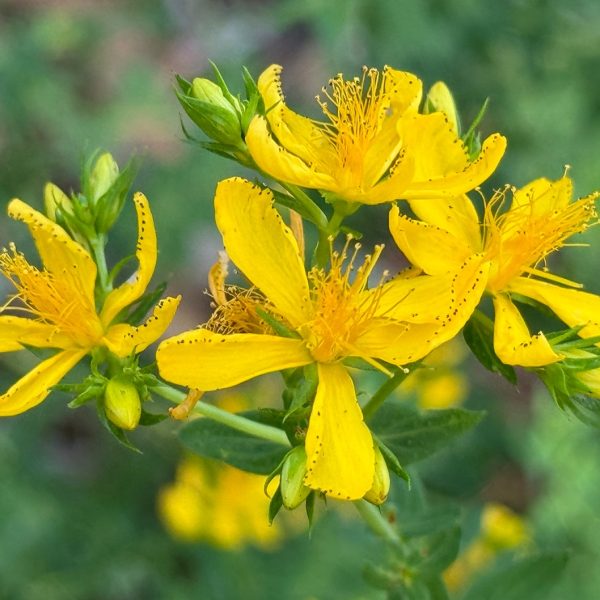
St John’s wort has long been given traditionally for nerve conditions, and as a folk remedy for different types of neuralgia (nerve pain), both when taken internally and when applied topically. It is also considered anti-inflammatory, which may be attributed to the presence of the phytochemical hyperforin (10). However, there is a lack of evidence using scientific methods to support this.
Modern herbalists indicate St John’s wort specifically in cases of sciatica (11), and consider it a nervine trophorestorative, so helpful in restoring the quality and function of nerve tissue, as well as being relaxing and restorative, particularly in cases of anxiety and depression.
California Poppy is specifically indicated in cases of nerve-generated pain, including sciatica. It can be taken in acute doses for pain flare-ups, as required (11), and regularly as part of ongoing management. It is also known to relax tense muscles, which may be helpful whether muscle tension is a result of sciatic pain, or the origin.
It is a nervous system relaxant, so helpful when anxiety, insomnia, and restlessness accompany sciatica.
Californian poppy can be taken as an extract, tea, or applied topically as a salve for easing muscular pain which may be helpful when sciatica is accompanied by muscle spasms and aches in the local area.
Jamaica dogwood has analgesic properties and is indicated specifically for nerve pain and sciatica (11). The sedative properties of this herb make it helpful when there is insomnia of nervous origin or when sleep is disturbed by pain. It is beneficial in cases of anxiety and emotional stress, so will be helpful for cases of sciatica accompanied by these.
Rosemary is wonderful at relaxing muscle spasms, and can be helpful in cases of muscle aches, sciatica, neuralgia (11).
Holistic solutions

An overview of sciatica management recommends that lifestyle changes which support healthy living are implemented to reduce the burden of sciatica. These suggest reducing modifiable risk factors associated with sciatica, including:
- Smoking
- Obesity
- Prolonged standing and bending forwards
- Heavy manual labour
- Heavy lifting
And adapting the following practices which have been shown as effective against sciatica (2):
- Walking
- Cycling
- Physical exercise (in general remaining active can help to reduce the severity of sciatica)
- Weight control
The following can also be helpful in the management of sciatica:
- Physiotherapy
- Massage
- Heat Packs
- Sleeping with support under knees (when sleeping on the back), and between knees (when sleeping on the side)
- Acupuncture
References
- Davis D, Maini K, Taqi M, et al. Sciatica. In: StatPearls [Internet]. Treasure Island (FL): StatPearls Publishing; 2024. https://www.ncbi.nlm.nih.gov/books/NBK507908/. Accessed April 6, 2024.
- Fairag M, Kurdi R, Alkathiry A, et al. Risk Factors, Prevention, and Primary and Secondary Management of Sciatica: An Updated Overview. Cureus 2022:14(11):e31405. DOI 10.7759/cureus.31405.
- Ropper AH and Zafonte RD. Sciatica. N Engl J Med 2015;372:13.1240-1248. 2015. DOI: 10.1056/NEJMra1410151. https://www.nejm.org/doi/full/10.1056/NEJMra1410151.
- Sciatica. MSD Merck Professional Version. https://www.msdmanuals.com/en-gb/professional/musculoskeletal-and-connective-tissue-disorders/neck-and-back-pain/sciatica. Accessed April 7th, 2024.
- Hicks BL, Lam JC, Varacallo M. Piriformis Syndrome. In: StatPearls [Internet]. Treasure Island (FL): StatPearls Publishing; 2024. https://www.ncbi.nlm.nih.gov/books/NBK448172/. Accessed April 6, 2024.
- Cook CE, Taylor J, Wright A, Milosavljevic S, Goode A, Whitford M: Risk factors for first time incidence sciatica: a systematic review. Physiother Res Int. 2014;19:65-78. 10.1002/pri.1572.
- Sciatica. NHS Inform. https://www.nhsinform.scot/illnesses-and-conditions/muscle-bone-and-joints/conditions/sciatica/. Accessed April 6, 2024.
- Sciatica. NHS. https://www.nhs.uk/conditions/sciatica/. Accessed April 6, 2024.
- Frawley D, Lad V. The Yoga of Herbs. 2nd ed. Twin Lakes: Lotus Light Publications; 2008.
- Dell’Aica I, Spiridione G, Rosy C. The Renaissance of Hypericum perforatum: Bio-Medical Research Catches Up with Folk Medicine. Current Bioactive Compounds. 2007;3:(2):109-119(11). Bentham Science Publishers. DOI: https://doi.org/10.2174/157340707780809644.
- Bone, K, The Ultimate Herbal Compendium. Warwick, Queensland: Phytotherapy Press; 2007.