


An ancient, fire-adapted palm of the southeastern United States, saw palmetto (Serenoa repens) sustains wildlife, livelihoods, and a global medicinal trade.
Meet saw palmetto
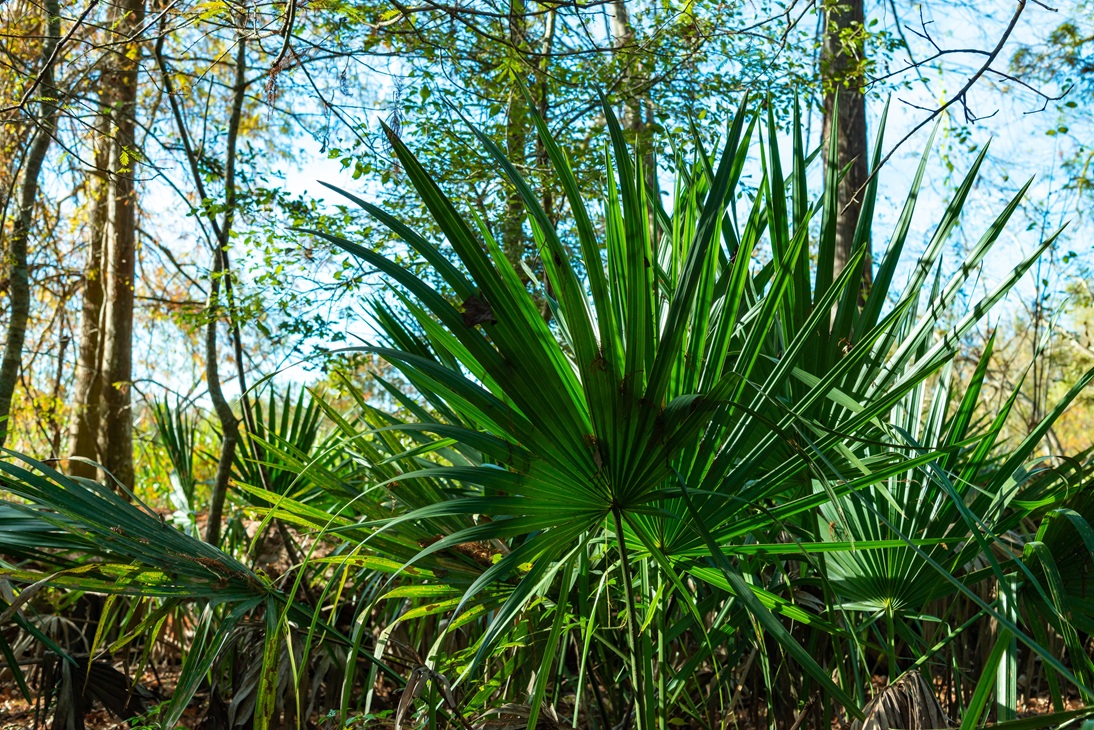
Saw palmetto (Serenoa repens) is a low-growing, shrubby palm native to the southeastern United States. The stem of saw palmetto is usually very short, and produces several stalks from which divided, fan-shaped leaves appear. These can span up to a meter across and may be composed of 18–30 segments. The leaf stems (petioles) have fine, sharp spines or teeth along the edges — giving the species its common name, saw palmetto. Clusters of white fragrant flowers, which grow on stalks give way to berries, which turn from green to orange to a purplish-black colour when ripe (1).
Saw palmetto grows as an undergrowth in forests, and on coastal sand shrubby areas. It’s an incredibly resilient plant, thriving on nutrient poor, acidic soils and being well adapted to fire disturbance. After fire, the plant grows rapidly, resprouting from root crowns and rhizomes. Periodic fires every five years seem to be beneficial to flowering and fruiting. However, being exposed to fire periodically, also helps to keep populations at bay, as without fire Serenoa repens soon completely dominates other plant species (2). Traditionally, fire was implemented by indigenous people to keep plant populations healthy but also in balance with other plant species (2).
Saw palmetto is native to the southeastern United States — Alabama, Florida, Georgia, Louisiana, Mississippi, South Carolina, which means, globally speaking, it has a fairly small natural habitat (1). In those areas, it can form unbroken plant populations that stretch for many miles (2). Seeds tend to have a very low germination rate, and the main way of reproduction seems to be mostly vegetatively via woody rhizomes lying on or just below the soil surface. Plants grow very slowly, but they can become very old, individual stems reaching 500 to 700 years of age, and some clonal patches are estimated to be around 5000 years old.
Saw palmetto and its role in the wider ecosystem
Saw palmetto is considered a keystone species — a species on which many other species in the ecosystem rely — as more than 100 bird species, 27 mammals, 25 amphibians, 61 reptiles, and countless insects use it as food and/or cover, including endangered species of bears and panthers (4). The flowers are an important source of pollen for insects, with over 300 different species of insects visiting the flowers (5).
By indigenous people, this plant was cherished as well and used in various ways. The berries were eaten as a food and used as medicine (6), the stalks were used to gain fibres for basketry, and the leaves used as thatch and for bedding material (2,6). In Florida, saw almetto is very common, covering vast areas of land, to the point that it used to be considered a pest by land developers and farmers, and pesticide use was encouraged to manage it (3).
Going into business

Westerners started using and selling saw palmetto as medicine in the late 19th century, when it soon became popular. In the 1890s 250 tonnes of the berries were being used to make extracts (3). However, since herbal medicine lost popularity in the 19th and 20th centuries, trade with saw palmetto didn’t see another burst until the 1970s, when herbal medicine had a resurgence of interest.
Until the late 20th century, saw palmetto was mainly conceived as a pest species, to be eradicated with the use of machinery and herbicides to free the land for agricultural or land developmental uses (7). But with increasing interest in saw palmetto berries as a medicine, particularly from European countries, and increased research, providing evidence for its use, demand for the berry soon rocketed. Until then, harvest and sales of palmetto berries happened mostly under the radar. The harvest was mostly done by migrant farm workers who received a few cents per pound. But as the demand went up, so did the prices and harvesters could get as much as 3.00$ per pound. This led to land owners and the state of Florida to show more interest and soon harvesters needed the land owners permission to harvest the berries from plants growing on their land (8).
Landowners hired crew leaders, who in turn would employ harvest crews to do the actual harvest. Landowners would typically receive $0.44–0.46/kg, with $0.15-0.17/kg going to the pickers and $0.07/kg going to the crewleaders. For landowners this represents a lucrative business, potentially creating more yearly income than from cattle, which the land would normally be used for (7). In the following years, the demand remained high, although supply tends to fluctuate, as fruiting seems to follow a boom and bust pattern, some years bringing much higher yields than other years. And fruiting success is generally fairly low for saw palmetto.
Additionally, extreme weather events, especially large amounts of rain, can severely impact maturation and harvest rates (10). In 2010 worldwide sales of saw palmetto supplements were approximately US $700 million, with the United States accounting for US $200 million alone — showing the high demand for this crop.
Regulation of saw palmetto harvest
Since the boom of saw palmetto, more and more voices have spoken out to regulate the saw palmetto trade, as nature conservationists highlight that the berry is a vital food source for wild animals. In 2018 the Endangered Plant Advisory Council of the Florida Department of Agriculture and Consumer Services added saw palmetto to Florida’s “commercially exploited plant list”. As a result of this, a “Native Plant Harvesting Permit” is now required on top of the land owner’s permit to be able to harvest saw palmetto fruits.
From July 2024, the illegal harvest or possession of saw palmetto berries is treated as a third degree felony, punishable by up to five years of prison. Since then, several instances of saw palmetto theft have been reported (11,12,13). One of these included approximately 768 kg of berries worth $3,309 (13). A question that remains open is how the increasingly abundant and restrictive regulations affect the already marginalised harvesters of saw palmetto.
Social welfare issues

Florida has one of the largest farming communities of the United States with over 100,000 farm workers (14). Two thirds are seasonal workers and one third migrants, all generally earning a marginal income. And the “contracting” system, by which a work force is contracted to work on farms via middle men (crew leaders) can make it very difficult to take action against abuse within the work force.
The Coalition of Immokalee Workers (CIW), a worker-based human rights organisation internationally recognised for its achievements in the fields of social responsibility, human trafficking, and gender-based violence at work has recorded several cases of gross abuse of human rights between 1997–2010, where workers were forced to work against their will, sometimes through threats, by retaining their passports or the use of physical violence (15). Other cases illustrate very demanding working conditions, 12 hour working days, six days a week, for as little as 20$ a week (15).
While no cases are specifically known regarding the harvesters of saw palmetto, as there is little transparency within the saw palmetto trade, it is impossible to positively exclude the likelihood of these conditions for harvesters. Saw palmetto harvest is hard work, partly due to the intense heat during the harvest months, but the plant itself makes harvest difficult. Thickets of saw palmetto stands can be too thick to penetrate, and the teeth on the stalks can rip clothing and cause wounds, and venomous snakes can hide between plants. Death of saw palmetto harvesters due to snake bites has been mentioned in the literature (16).
Conservation status now and in the future

Overall Serenoa repens is considered as ‘apparently secure G4’. Populations in Mississippi and Florida are secure, while in South Carolina they are deemed ‘vulnerable’ and in Louisiana ‘critically imperiled’. Georgia and Alabama have not been assessed at this time (17).
The American Botanical Council raises concerns regarding its future sustainability. The greatest threats to saw palmetto today are habitat loss due to land change use — i.e. land being turned into agricultural land for crops, or converted to urban land. It is perhaps noteworthy that not all regulations seem to make sense in this regard. While berry harvest is seen as a threat to wildlife, land conversion to agricultural or urban land, doesn’t seem to be considered with the same vigor, even though arguably it presents a greater threat — though perhaps a better economical bargain. Climate change is a challenge for berry crops, as severe rainfall can cause fungal infections that affect the berries. It also represents long-term challenges as sea-level rises are predicted to affect the local coastal areas, one of the main habitats for saw palmetto (16).
However, other climate change effects are predicted to extend saw palmetto’s natural habitat inland, potentially increasing its habitat (18). This highlights the complexity of climate change, and how challenging it can be to accurately predict long-term impact. Some saw palmetto clone patches are said to be 8.000 years old, showing just how resistant they can be (19).
However, the land changes brought about due to human activity might yet prove more damaging — as with the Amazon rainforest, which has survived at least 50 million years of various climate changes, yet may fall due to the impact of fairly recent human activity on the land.
Future outlook
Perhaps saw palmetto shows a contrasting affair, where economical interest offers some level of protection of natural resources, but whether this is enough is unclear. A lack of transparency and sustainability incentives means that those involved in harvest are at risk of exploitation and further marginalisation.
With a plant that is in such high demand, there is great potential for development; either to expand an already extractive mindset, or to provide a fair system that benefits local wildlife, wild harvesters and everyone involved in the supply chain. There are projects out there that demonstrate that wild harvesting can be done in such a way, prioritising fairness, people and the planet, whilst retaining economic viability.
References
- Royal Botanical Gardens, Kew. Serenoa repens – saw palmetto. Accessed November 24, 2025. https://www.kew.org/plants/saw-palmetto Kew Gardens
- Anderson MK, Oakes T. Plant Guide for Saw Palmetto (Serenoa repens). USDA-Natural Resources Conservation Service, National Plant Data Team; 2012: Davis, CA.
- Foster S. Saw palmetto in commerce — Part 1: Revelations from European contact to 1990. Sustainable Herbs Initiative. 2019. Sustainable Herbs Initiative
- Maehr DS, Layne JN. Florida’s all-purpose plant, the saw palmetto. The Palmetto. 1996;16(4):6-10, 15, 21. suncoast.fnpschapters.org
- Deyrup M, Deyrup L. The Diversity of Insects Visiting Flowers of Saw Palmetto (Arecaceae). Florida Entomologist. 2012;95(3):711-730. https://doi.org/10.1653/024.095.0322
- American Botanical Council. Saw palmetto berry. In: Expanded Commission E Monographs. Accessed November 25, 2025. https://www.herbalgram.org/resources/expanded-commission-e-monographs/saw-palmetto-berry/
- Carrington ME, Mullahey JJ, Krewer G, Boland B, Affolter J. Saw palmetto (Serenoa repens): an emerging forest resource in the southeastern United States. South. J. Appl. For. 2000;24(3):129-134. ResearchGate
- Foster S. Saw palmetto sustainability — change in 140 years of commerce and conservation: 1879-2019. Sustainable Herbs Initiative. 2019. Sustainable Herbs Initiative
- Carrington ME, Mullahey JJ. Effects of burning season and frequency on saw palmetto (Serenoa repens) flowering and fruiting. For. Ecol. Manag. 2006;230:69-78. faculty.nelson.wisc.edu
- Gafner S, Baggett S. Adulteration of saw palmetto (Serenoa repens). Version 3. Botanical Adulterants Prevention Bulletin. 2018.
- Farrow H. What are saw palmetto berries, and why would someone steal 800 pounds of them? Tampa Bay Times. August 28, 2024.
- Gay N. Florida saw palmetto berry bust leads to 11 arrests and seizure of 6,000-pound bounty: MCSO. FOX 13 Tampa Bay. Published August 13, 2025. Accessed December 14, 2025. https://www.fox13news.com/news/florida-saw-palmetto-berry-bust-leads-11-arrests-seizure-6000-pound-bounty-mcso
- Franklin O. Martin County detectives arrest 10 men on charges involving theft of palmetto berries. Treasure Coast. Published 2025. Accessed December 14, 2025. https://eu.tcpalm.com/story/news/crime/martin-county/2025/08/13/detectives-arrest-11-related-to-illegal-palmetto-berry-harvesting/85642986007/
- Rural Neighborhoods. Florida’s farm workers. Accessed November 26, 2025. https://www.ruralneighborhoods.org/what-we-do/farm-workers/floridas-farm-workers/
- Coalition of Immokalee Workers. Slavery in the Fields and the Food We Eat. Accessed November 26, 2025. https://ciw-online.org/wp-content/uploads/12SlaveryintheFields.pdf
- Foster S. The historical interplay of plant biology, trade, and human interactions with saw palmetto. HerbalGram. 2021-22;123:36-67. GlobeNewswire
- NatureServe Explorer. Serenoa repens – saw palmetto. Accessed November 26, 2025. https://explorer.natureserve.org/Taxon/ELEMENT_GLOBAL.2.139448/Serenoa_repens
- Butler CJ, Larson M. Climate change winners and losers: The effects of climate change on five palm species in the Southeastern United States. Ecol Evol. 2020;10(19):10408-10425. Published 2020 Sep 1. https://doi.org/10.1002/ece3.6697
- Ancient Saw Palmettos in the Heart of Florida – United Plant Savers. United Plant Savers. Published January 7, 2019. https://unitedplantsavers.org/ancient-saw-palmettos-in-the-heart-of-florida/